“We’re not sure if we’re going to recertify.”
A B Corp CEO told me this recently. Sales were slow, competitors were winning deals, and the new B Corp standards seemed like one more burden when cash was already tight.
To be honest, it’s something that I’m hearing a lot as CEOs decide how to meet the new B Corp standards.
However, here’s what the CEO wasn’t considering as they contemplated whether or not the company would remain a B Corp: the new B Corp standards aren’t just compliance requirements—they’re a comprehensive framework for building a competitive advantage for your company.
This article breaks down how each of the seven Impact Topics creates measurable business value. By the end, you’ll understand why early adopters who master these standards will have an advantage over those who scramble to catch up in a couple of years or who choose not to recertify.
The Unpleasant Reality of the B Corp Silo Effect
In my work guiding B Corps through certification, I regularly see that companies silo their B Corp work from the business strategy.
The CEOs I work with tell me that their primary concern is revenue generation and scaling, yet B Corp certification rarely comes up as a strategic asset in those conversations.
Instead, it’s sometimes handed off to an admin who completes the assessment when it’s time to recertify; in those cases, the recertification is basically handled as isolated compliance work.
At other times, it’s delegated to an Impact Manager who tracks KPIs and prepares an impact report; in those cases, it’s viewed as important work to be resourced, but it still remains separate from the company’s revenue and growth goals.
In both cases, the certification is viewed primarily as impact work – there’s a gap between the B Corp work and the company’s overall business strategy and priorities.
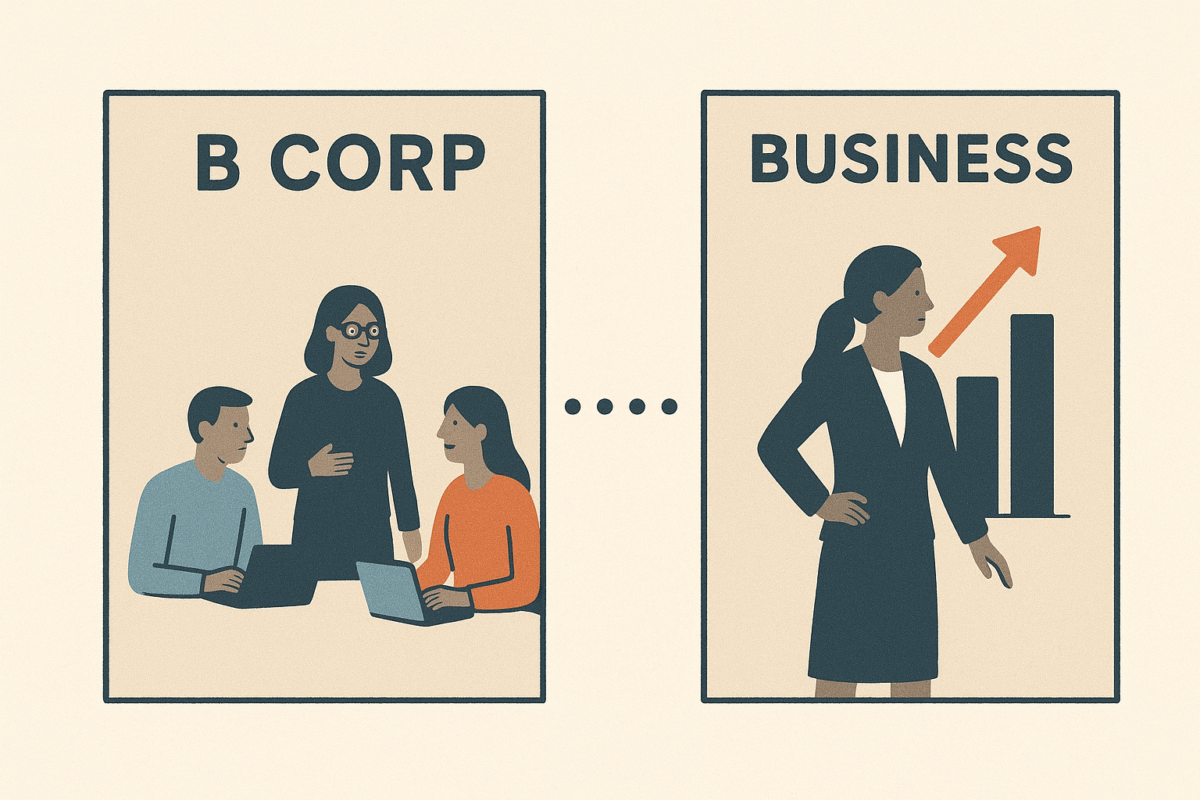
When B Corp work is siloed like this, it’s a challenge to fully understand the value of what the certification brings.
At best, it’s a necessary compliance activity, something that has to get done but that doesn’t support the actual business in a meaningful way.
At worst? It’s a drudgery and a cost center, easy to jettison when B Lab raises the bar and sets new standards for B Corps to meet.
However, there’s a better approach that CEOs can take: systematically integrating B Corp standards into the business to build a strong competitive advantage. Taken together, the new standards can provide companies with a distinct strategic advantage if they approach B Corp certification as an asset that benefits the company.
| B Corp as Compliance Burden | B Corp as Strategic Advantage |
| Admin or impact manager manage certification with minimal leadership involvement | CEO and leadership integrate B Corp into business strategy |
| Viewed as cost center that doesn’t add value | Viewed as investment that provides competitive advantage |
| Race to check off the boxes before the recertification deadline | Systematic implementation of impact practices throughout the certification period |
| Requirements seen as onerous tasks to overcome | Requirements seen as framework for business resilience |
| Team questions value of continuing certification | Team leverages certification in marketing, sales, and talent acquisition/retention |
| By 2028: Scrambling to meet new standards | By 2028: Years of documented practices to showcase impact & market leadership |
The B Corp Strategic Framework: 7 Competitive Advantages
The new standards consist of 7 Impact Topics, each of which delivers distinct business benefits for B Corps. By meeting these requirements, your company can unlock advantages that can lead to long-term success.
Note that the descriptions below are summaries of the key requirements of each of the Impact Topics, and may vary based upon company size and industry. Log in to your B Impact portal to see the requirements that apply to your particular company.
Building Strategic Differentiation Through Purpose & Stakeholder Governance
This fundamental Impact Topic requires that companies establish a public purpose to have a positive social and environmental impact and that they regularly engage all stakeholders. A key principle for B Corps is that companies should consider how they impact all stakeholders – anyone who is affected by how a company operates – not just shareholders. This Impact Topic ensure that B Corps are doing just that.
How the company benefits:
- Gains clarity on the company purpose and aligns the team on what matters most
- Stands out from competitors with a genuine purpose and stakeholder focus
- Builds deeper trust with stakeholders, including workers, clients, and suppliers
- Catches potentially problematic issues early through stakeholder input
What the data shows:
- 14% higher revenue growth for purpose-driven companies compared to other companies
- 64% of customers find companies that actively communicate their purpose more appealing
- 78% of consumers were more likely to remember companies with a strong social purpose
- 78% of people prefer to work for a purpose-driven company
Creating Competitive Talent Advantages through Fair Work Practices
Within this Impact Topic, companies are required to treat workers fairly, pay fair wages, and consider worker feedback on decisions that affect them. It’s designed to ensure that B Corps are taking care of and being responsive to one of their key stakeholder groups: workers.
How the company benefits:
- Attracts better candidates, retains great people, and reduces turnover costs
- Gets better ideas and more buy-in on decisions that affect employees
- Reduces legal and compliance risks by proactively developing a positive workplace
What the data shows:
- 8.5x greater revenue per employee
- Workers are 4x more likely to stay with a positive workplace culture
- 67% less turnover at companies that provide a great place to work
Driving Innovation and Attracting Diverse Talent with Justice, Equity, Diversity, & Inclusion (JEDI)
JEDI standards require measuring diversity data and taking concrete action across three categories: Foundation, Within the Workplace, and Beyond the Workplace. The new standards don’t require that companies engage in any specific actions; rather, they provide companies the flexibility to choose the ones that are most suitable for them.
How the company benefits:
- Increases revenue, margins, and market share
- Attracts great candidates who value diversity and inclusion
- Generates better ideas and solutions through diverse viewpoints
- Keeps good workers by providing a psychologically safe, inclusive work environment
What the data shows:
- 36% greater likelihood of higher margins for diverse companies
- 19% higher innovation revenue
- 51% higher market share
Protecting Brand Reputation and Operational Integrity Through Human Rights Due Diligence
The B Corp Human Rights standards require making a public commitment to respecting human rights, identifying potential risks across operations and supply chain, and taking action by screening clients, projects, and procurement while working with suppliers to address risks.
How the company benefits:
- Protects brand reputation and consumer trust through due diligence
- Catches potential legal problems through proactive human rights management
- Stands out as an industry leader on human rights
- Attracts human rights-conscious investors, customers, and partners
What the data shows:
- 20% increase in customer loyalty when sourcing ethically
- 25% profitability increase for companies that supported better work practices in factories
- 88% of consumers prioritize buying from companies with ethical sourcing practices
Staying Ahead of Competitors and Attracting Talent Through Climate Action Leadership
The Climate Action standards require measuring greenhouse gas emissions, setting science-based reduction targets, and implementing climate transition plans contributing to net zero by 2050. They push companies of all sizes to take meaningful action on the central environmental challenge of our time: global warming.
How the company benefits:
- Stays ahead of competitors through demonstrated climate leadership
- Builds trust with climate-conscious workers, customers, investors, and partners
- Contributes to preventing the worst effects of climate change, which will affect all businesses
What the data shows:
- 66% of employees want their employers to invest in sustainability initiatives
- 70% of companies reported higher than expected financial returns from climate action
- 20X ROI on climate initiatives
Driving Innovation & Building Customer Loyalty with Environmental Stewardship & Circularity
The Environmental Stewardship & Circularity Impact Topic requires that companies minimize environmental impacts across operations, track resource use, and reduce waste. In addition, companies are prompted to leapfrog ahead of competitors by implementing circular economy principles in product design.
How the company benefits:
- Cuts costs through reduced resource use
- Builds trust with environmentally conscious stakeholders, including workers and customers
- Stands out as an industry leader through environmental leadership
- Develops innovative products by applying circular design principles
What the data shows:
- 9.7% is the premium that consumers are willing to pay for sustainable products
- 31% share of market growth from sustainable products, even though they only account for 18% share of the market
- 71% of consumers say they are more loyal to companies that take an active role in protecting the environment
Amplifying Impact & Attracting Customers through Government Affairs & Collective Action
The Government Affairs & Collective Action Impact Topic requires that B Corps engage in responsible tax practices and that they participate in collective action for systemic change. These requirements compel B Corps to look beyond the boundaries of their own company to engage with others to advance massive change – the hallmark of the B Corp movement.
How the company benefits:
- Establishes industry leadership by actively participating in systemic change initiatives
- Strengthens stakeholder relationships through a collaborative approach to social and environmental challenges
- Gains access to networks and partnerships that drive innovation and opportunities
- Stands out from competitors by demonstrating commitment to broad, positive impact
What the data shows:
- 52% consumers purchase from brands that support causes they care about
- 60% of consumers are buying, choosing, or avoiding brands based on their politics
- 63% of Gen Z and 57% of Millennials are more likely to buy from companies that speak out about specific causes
From Compliance Burden to Resilience
The data shows that the new B Corp standards are not just an onerous set of requirements. Rather, they provide a framework for companies to adopt in order to both have a positive impact in the world and realize the competitive advantages that come with it.
For companies that choose to meet these standards, what’s the end result? How will the company be transformed?
Here’s what it will look like: A company operating with a clear purpose, engaging with stakeholders, building a positive workplace culture, treating people with dignity, taking action on the climate crisis, demonstrating environmental stewardship, and working collectively with others.
A company that does all this is poised to become a leader in its industry. It has an authentic story to tell. It has a brand that stands for something, which attracts clients and customers. It attracts good workers who want to be part of its mission.
In short? The company is resilient.
The difference between companies that see the new standards as a burden versus opportunity makes all the difference in the results that they’ll see.
Companies that view B Corp certification as a compliance burden may drop the certification or just do the bare minimum to check off the boxes right before it’s time to recertify.
Companies that view B Corp certification as a strategic advantage will commit to meeting the standards, to ensuring that the impact work is tied to the company strategy, and then to using the certification to grow the business.
This is something that all companies, even the smallest, can do. If anything, it will be harder for the larger companies to meet the standards and therefore to leverage it.
Should We Wait to Prepare for Recertification?
Adopting the new B Corp standards now positions your company as a leader, not a follower.
The early adopter advantage matters here. In a couple of years, companies that moved first will have a strong track record and will be ahead of others in impact, stakeholder relationships, and talent. They will have a clear, credible story to share with customers and clients and will find it easier to keep meeting the standards as they continue to evolve.
Starting well before the deadline lets you build these practices into day-to-day operations and collect real results instead of scrambling at the last minute. Early movers are seen as leaders, while companies that delay will be stuck trying to catch up.
There’s a reason why B Lab has consistently referred to the new standards as “raising the bar” – these are forward-looking practices that very few companies are doing. Some will choose to level up to meet the standards, to maximize their positive impact, and to realize the competitive advantages that come with it. Some will not.
One way to get started quickly is to join the B Keeper Collective, a unique community designed to provide you with the guidance, resources, and support to successfully complete your recertification.
What will your company choose?
Transform Your B Corp Certification Into Competitive Advantage
The difference between companies that thrive under new standards and those that struggle comes down to the approach that they take.
If you’d like to take a strategic approach to your recertification, schedule a discovery call to explore how the new B Corp standards can help you to build a stronger business.

Carolina Miranda is the Founder and CEO of Cultivating Capital, a Certified B Corp since 2012, that helps companies implement impact and sustainability practices by making complex requirements clear, manageable, and actionable. As a B Corp ROI Strategist, she specializes in helping companies to recertify, measure, and manage the ROI from their certification.
With 15+ years in the B Corp movement, Carolina has been teaching B Corp standards since 2023 and is recognized for her expertise with the performance requirements. She’s been trained by B Lab twice, including as an external verifier in 2021 and as a B Corp Consultant in 2023. Carolina has received the 2020 Community Builders Award and the 2024 Hal Taussig Award for her contributions to the B Corp community.